
City Reservoir, Rethinking tourism, creating anonymous encounters, redrawing the function of the city’s cultural center.http://fundacionmosis.com/English/reserve_ciudad.htm

Summary. The goal of City Reservoir is to enhance the intellectual and existential aspects of city life, while raising an awareness of ecologies of the immaterial. Using a combination of mapping, artist-led tours, archiving and the publication of a book, the project seeks to highlight the importance of those aspects of the city that are often overlooked by other contemporary forms of urban entertainment and cultural production, aspects of an immaterial ecology.
If a ‘National Park’ is a designated tract of land meant to preserve the landscape’s natural beauty by protecting nature from further exploitation, then the designation, City Reservoir, might be interpreted as meant to protect mental activity, to prevent ‘the civic’ from being subdued, and to prevent cities from becoming simply places for consumption: the city seen as an international civic plaza rather than a place that is just crowded; an intellectual park, containing the one and the other in all its chaos and its freedom!

Mapping is a tool for reflection and generation presents a utopian city that cannot be physically built but that can be projected through drawings. By redrawing the city and leading visitors this redefined, redrawn space, you are leading them into a utopia. Mapping recognizes existing gaps in the city and through filling these gaps with desires, create a new unknown. Mapping point out planning strategies.
We will visit the maps, the addition of the real city and the projected city and that way we will re-visit the city. Here the projected vision of the city encounters the real, showing the gaps and potentials. Visiting the maps is another step for the maps makers to reconsider what they did and it is a learning experience of the visitors, that will be educated in the translation of real and utopian, space and map. These tours, are in the sense “detours”, because switch trajectories from what is expected. They are city visits that do think about the city and about tourism at the same time than doing tourism. These are no tours to the art places. These visits try to consolidate the relation-ship between two entities: the individual and the city. As a result of the “tours” will have a series of cultural object that will archive the cities.

Example 1, The city that a tourist walks versus the city that a resident walks.
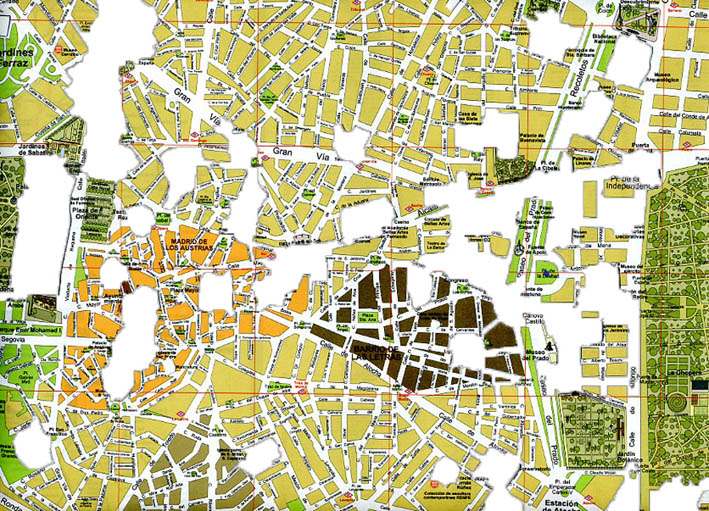
“Madrid”. Project: “City Reservoir Madrid” 2009
Following a straight line through the center of Madrid from Bilbao to Legazpi, a tourist will continue on without encountering any of the traditional urban and cultural monuments. “City-Reservoir” is
a lagoon within the middle of the city. The monuments stay on the two sides of the reservoir: on the left-hand side, the “Palacio Real”;on the right-hand side, the “Paseo del Prado” and the “Retiro.” This line connects all the popular ‘plazas’ within the area: “Plaza Dos de Mayo,” the “Plaza de Chueca,” “The Sevilla Plaza,” the “Plaza de Santa Ana,” “Plaza Lavapies,” and reaches to “Plaza de Lepazpi.”“Madrid Matadero” in Legazpi –once the ‘meatpacking’ district of Madrid, is now an art center.
Maps of the possible and potential cities in our city. Each design criterion produces a different city. A group of architects and artists working to made author’s maps. Maps are downloaded to lead a visit from the Blog (in low quality and free of charge) or as an object (high quality, you can request a serial screen).

Barcelona, map of a walk
__________________________________________________________
Summary. The goal of City Reservoir is to enhance the intellectual and existential aspects of city life, while raising an awareness of ecologies of the immaterial. Using a combination of mapping, artist-led tours, archiving and the publication of a book, the project seeks to highlight the importance of those aspects of the city that are often overlooked by other contemporary forms of urban entertainment and cultural production, aspects of an immaterial ecology.
If a ‘National Park’ is a designated tract of land meant to preserve the landscape’s natural beauty by protecting nature from further exploitation, then the designation, City Reservoir, might be interpreted as meant to protect mental activity, to prevent ‘the civic’ from being subdued, and to prevent cities from becoming simply places for consumption: the city seen as an international civic plaza rather than a place that is just crowded; an intellectual park, containing the one and the other in all its chaos and its freedom!

Project’s concepts MENTAL CITY. What is accepted is that cities become desirable when they are viewed as being commercial and service centers for a broad population. But it is not recognized that mental and abstract activities also define the city. Besides, being places of opportunities (better jobs, education, better living conditions, education, access to all) and entertainment, cities are places for thinking, (humanism in its wide spectrum: memories of past events, records of achievements, the spread of new ideas, places for sharing experiences) and experiencing (encounters among individuals, being part of something big). Cities are also the ‘mental reservoir’ of a country and the world. Since these reservoirs are always at risk of extinction, they need to be preserved. This intellectual life can be understood as part of that which is immaterial or unseen within the urban landscape. This culture of experience cannot be commodified or sold through the packaging of tourism, but rather is a slow unfolding that becomes present through an awareness of the subtle shifts of a city’s daily changes that build upon each other and can only be measured and revealed as registers of difference.

Project’s Concepts: PRESERVING A CITY
Two kinds of preservation come to mind: historical rehabilitation and the nature reserve. What remains are physical things: a forest, a building, a group of buildings, a tree as a natural monument, a waterfall, a beach. Yet where a nature preserve or reservoir seeks to maintain and propagate communities of species and their interactions (one could not imagine preserving a type of bird without also protecting its entire habitat) historical preservation is more often focused on singular objects. There are no models to maintain the existence of things that have no material, concrete existence such as participation in a square, the city environment, the degree of civility, those things that are linked to the architecture that supports them.
When the object of preservation is understood as something that has to be the same that was when firstly created -without taking into account the original situation, without translating the form of the object into present conditions- the object is frozen into the past, death. In addition, the generative force of production is left behind as that which is being preserved loses its use.
Cities are characterized by change, perhaps to preserve a city is not the right approach; the name reservoir implies the idea of change on its definition. A “reserve” of food, water or money keeps the idea of saving and growing without having as reference the “pre” existent condition. Urban implies complexity; rather than a homogeneous and passive center, rather that an image from the past, urban holds the desire of individuals exceeding their existence.
Project’s Concepts: ECOLOGY of the IMMATERIAL
If we apply ecology to cities, the result is that cities, beyond being economical-socio-cultural centers, are site’s for an inquiry into the nature of civilization. Ecology has been applied to the material but not to the immaterial. Classifying trash to facilitate recycling or replacing plastic bags with longer lasting ones does not have its equivalent in an immaterial ecology: replacing fashion and trends with long lasting principles; argumentative thinking that takes away the residual. Thinking is classifying and deciding, paying attention to what is really crucial in human existence. It involves rejecting words that do not involve meaning and instead using an argumentative discourse. Ecology is applied to reducing the use or creation of wasteful objects, but not to making thoughts that will clarify existence or bring progress. Ecology is not only about subtracting but adding. We try to reduce our trash but we trash others.

Project’s Concepts: THE IMAGE OR THE PROJECTION OF THE CITY
A city contains life, has a social structure and different communities. A city is comprised of both
material elements (architecture, monuments, urban structure, landmarks and educational resources) as well as immaterial ones (atmosphere, stories, myths). Through books, movies, songs and images, a city is shared with others who don’t necessarily live there. What is shared is mainly the abstract element of a city: its projection. However, more effort goes into the development of the physical elements of a city than its projection. The consequence is to offer a reduced version, a stereotype of what a city is. In order to think about the image that a city projects, it is necessary to support practices that offer a complex approach (arts, literature and architecture) rather than those that give a simple reading (publicity, TV, big production films). City Reservoir reflects on the destabilizing effect of tourism for the city: historical centers and monuments are preserved without putting the same attention to the daily rituals of place. This project includes the ethnological heritage and integrates residents with the tourists, avoiding the arrogant simultaneous contempt for the tourist and their exploitation. We are all tourists.
Project’s Concepts: CULTURAL TOURISM
When rethinking tourism, this project considers the tourist as an individual instead of treating tourism as simply an industry. Tourism as an industry shouldn’t imply industrialized tourism. Tourism should not exploit the tourist (who doesn’t come back) or/and the city (that stops being desirable). The principle is that if cities are rich on a cultural level, they will evolve into priority destinations. Tourism, considered an activity with cultural value in itself, in cities is often characterized as a visit to cultural locations, while forgetting about city life. It is necessary to rethink the meaning of “the cultural”. Cultural is the group of actions that overlay a form of living, and not simply a list of events and activities. From the economic point of view, to increase tourism in a city, it is necessary to invest in the city as a whole and not only in cultural activities; in addition, when considering the balance, the negative consequences that tourism imposes on a city need to be subtracted from the direct income it brings. If tourism is only about expending and not about generating, the city, as the object itself of tourism, will be extinguished and tourism will become unproductive. Tourism and art are two industries that depend on people; artists who once gave value to cities and attracted tourists, are pushed out through tourism’s consolidation.
Project’s Methodology
The concepts above articulate a problem about the relationship between city centers and their immaterial cultural aspects. Through the project, we hope to propose ways of thinking about the city that bring forward these unseen qualities while also providing tools for transforming tourism into an integral and productive part of the immaterial functioning and development of city life. We would like to propose a potential engagement between city centers and tourist, inhabitants and users who moves beyond the traditional ‘consumption’ based model of culture, instead promoting a relational and ecological understanding of interaction.
Rather than proposing to stop development, business or cultural operations, our approach is to insert actions that rethink production and activate the city as a mental entity intensifying an immaterial or urban ambiance. These actions can be described as vehicles; they are pragmatic steps that work together to describe a process that articulates the idea of a City Reservoir ultimately proposing a reframing of cultural activity within the city center that could go on to influence thinking about urbanism, urban preservation and cultural tourism.
The continuation of City Reservoir is IPI City
IPI CITY: The Index of Intangible Patrimony Associated with the Architectural and Urban Elements in a City
What is the IPI of your city? There will come a moment that this question will be as common as asking how green your city is. My project consists of creating the IPI, a concrete tool to measure the existential quality of life in a city. IPI city shows the impact of gentrification and withdrawment on the city. The index registers immateriality in the city. To create the index, I will draft a typology by sampling urban conditions in the city of New York.
Jana Leo de Blas
 Jana Leo