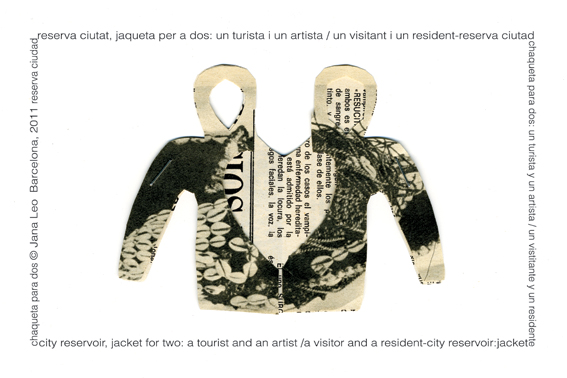
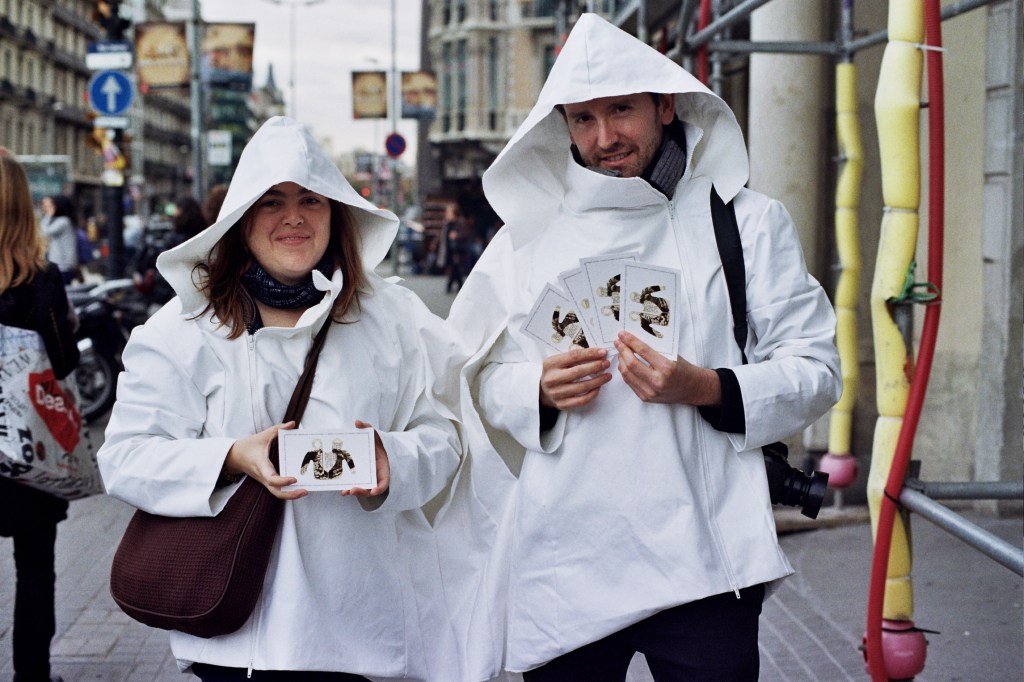
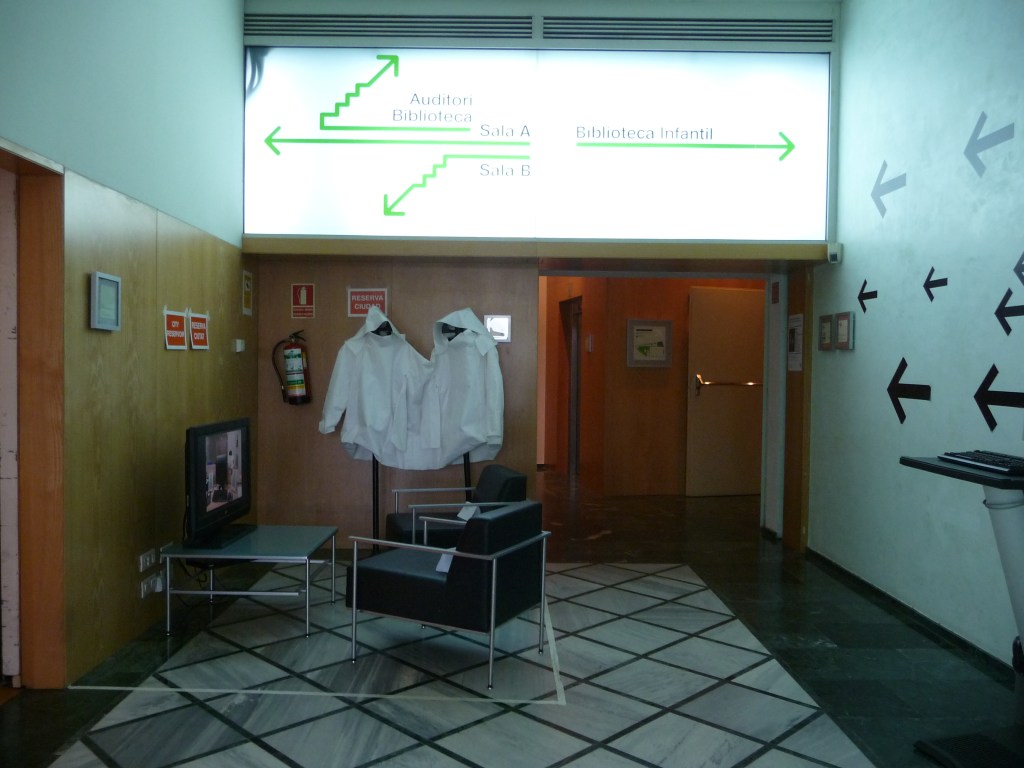
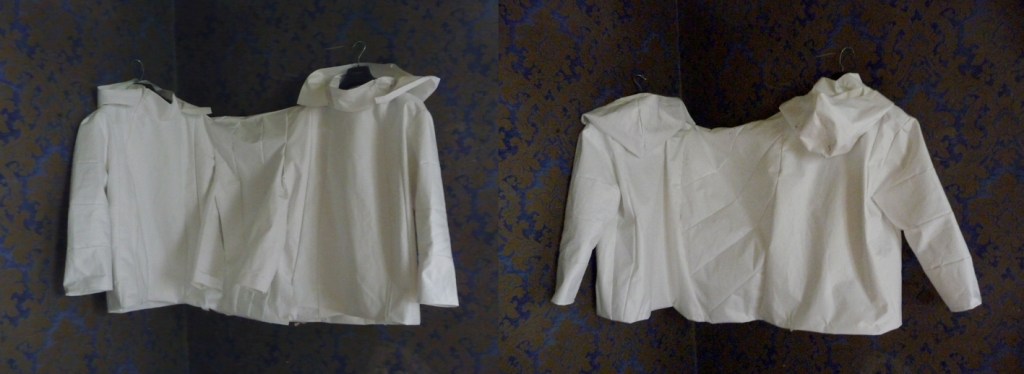
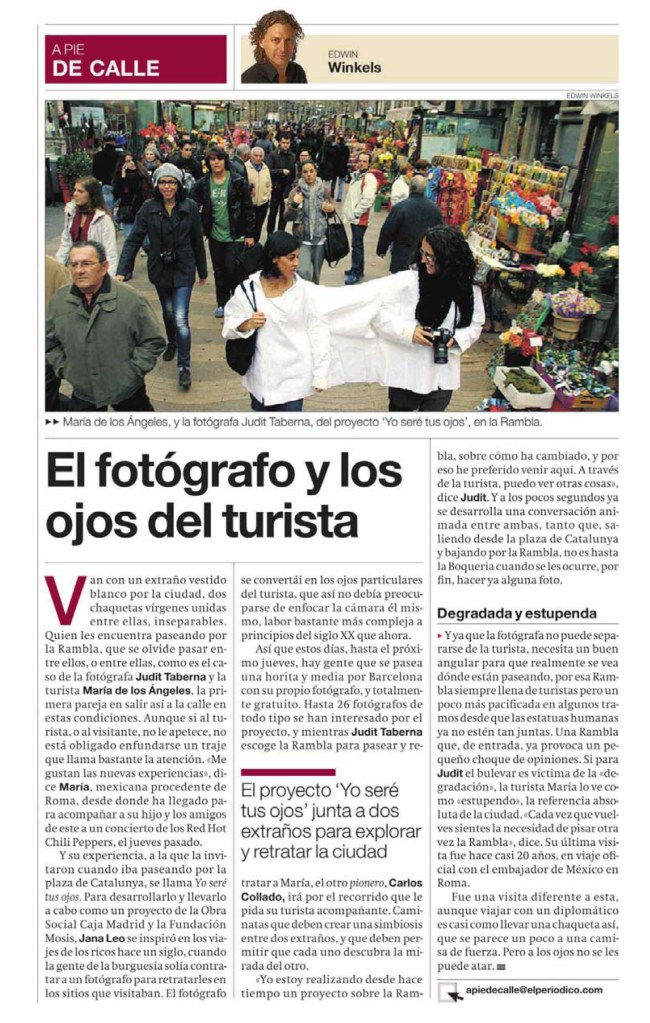
As a symbolic illustration of the walk and of the city reservoir, Barcelona, we designed: “jacket for two”. This “jacket for two” is a way to appropriate the city while visiting it (these two take space from the city for themselves). A little bit of science fiction and a little bit monastic: to put the jacket on is an entrance into another dimension. The jacket is a vehicle that one wears to change her/his mood. Primarily though, the jacket is intended to help facilitate an encounter between two unknown people in a city that is mainly known by one. The jacket serves as protection, not only from the weather but from judgment; when it is used for walking, it marks a bubble to walk in; used to publicize the project, it gives respect to the task of m postcards in the street. The white without logos or brand names contrasts with the highly charged advertising of city landscapes. “jacket for two” is an art piece, a form of publicity, and a manifesto about the relationship of one person with another and with the city.
“Jacket for two” -Idea Jana Leo -Making Jimena González
Vehicles: carrying concept of CITY RESERVOIR) into practice TOURS WITH A PHOTOGRAPHER
The tours are a way to experience the city and an encounter with another person: an artist and a visitor. Tours also facilitate intercultural dialogue crossed with two categories, artists, and tourist. Last but not least, tours create the frame for intimate and safe encounters to happen (only two individuals unknown to each other, go on a tour). This is one example: “I will be your eyes” A photographer goes with a tourist or visitor and takes pictures of what the tourist requests. The act of photographing is broken into two: the mind (the tourist); the eyes, and the hand, the machine (the photographer).The photographer needs to make an image that fits the tourist desire but also that questions the practice of a tourist taking pictures like sweeping the floor. The photographer, often using a digital camera, might shoot many versions of the same image following instructions from the tourist. This “tour” is a remembrance of the custom among the rich to travel with a photographer who would take pictures for you. Tours are individuals, one photographer and one visitor.
“I WILL BE YOUR EYES” A photographer goes with a tourist or visitor and takes pictures of what the tourist requests. The act of photographing is broken into two: the mind (the tourist); the eyes, and the hand, the machine (the photographer). The photographer needs to make an image that fits the tourist desire but also that questions the practice of a tourist taking pictures like firing a machine gun . The photographer, often using a digital camera, might shoot many versions of the same image following instructions from the tourist. This “tour” is a remembrance of the custom among the rich to travel with a photographer who would take pictures for you. The walks create a context in which two strangers and two categories: tourist and resident relate to each other intensively. Tours are individuals, one photographer, one visitor, but there have been some exception to the rule.
http://fundacionmosis.org/reservaciudad/
Photos are archived in City Photo Archive

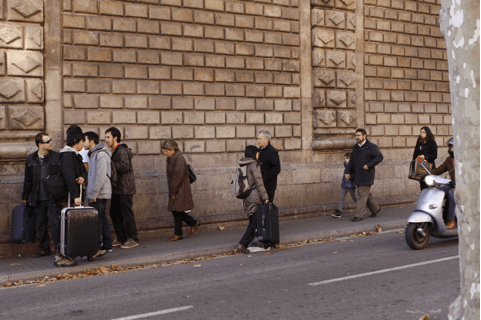
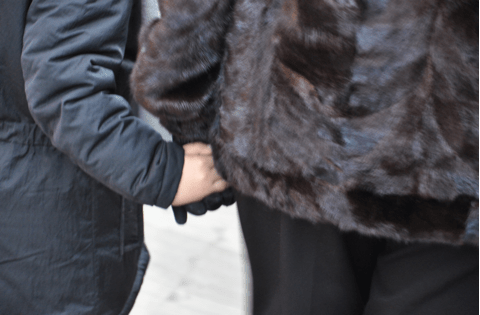
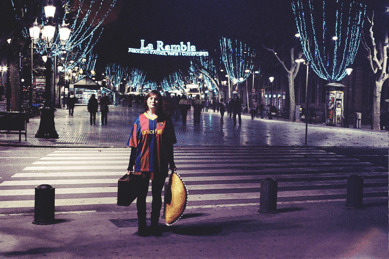
The meaning of the walks for tourists. A walk is the frame for two strangers and two categories (artists and tourist; visitors and residents) to share a certain intensity of exchange between photos and a city. Among the things that one remembers from a trip is the personal relations; in this case those are held in a photo series, ‘an author souvenir’. Relations happen by need; a self-sufficient city center visitor, or anonymous resident doesn’t ask for anything, nor does he or she give. Visitors and residents don’t relate in a way that could potentially strengthen both local and global communities, ultimately threatening the very ecologies that make city center’s historically vibrant and cacophonous places.
The meaning of the walks for residents. Without relations, a life where people do not relate to one another, there are no memories of experience (because there are no experiences) but just the proof of ‘being there’. The way one lives right now in a city, (detached) follows the pattern of a transaction and not of a relation; this is true not only for tourists but also for residents. Residents exclude themselves from engagement with the place they live and the people they live with. Residents often accept the role of watching just as tourists do. Denying the possibility of being able to have a real experience and provoke a change, the position of the resident today it is post-existential. This project tries to illustrate the difference between transactions and relation.
CREDITS: A project directed by Fundación Mosis (Models and Systems;Art and City); conceived by Jana Leo, produced by Obra Social Caja Madrid with the support of the Ministry of Culture of Spain.
Texts by Jana Leo; edited by Sony DevabhaktuniTechnical support: Simon Lund
Installation: Patrick Finchy
Project “Reserva-Ciudad” by Jana Leo in Matadero Madrid from October 1 to 25 2009.
Participating Photographers in Madrid: Borja Alvarez, Virginia de Diego, Noemi Larred, Jana Leo, Stephen Lucas, Simon Lund, Gabriella Moya, Juan Quesada, Lourdes Rey y Mariana Treviño.
Photographers: Abel Pau Garcia, Aizea Arce, Albert Pi, Andrés Gálvez, Carlos Collado, David Querol, Denise Koirach, Enric Sirera, Eugènia Canyelles, Eva Parey, Finchy Patrick, Garbiñe irizar, Judit Taberna, Konstantina Gavala, Manuel Serra, Monica Busquets, Nardi Bayarri, Noemi Muñoz, Ramon Vilalta, Rafa Barbas Cañero, Regina Barbas, Richard Vanderaa, Santos Montes, Sol Carrizo, Xavier Roldan
Support in communication: Aizea Arce, Noemí Muñoz, Patrick Finchy, Mapi Rivera, Arume Calvo
Art center support: Espai Cultural Caja Madrid en Barcelona de: Carmen Cruañas Padrosa, Antonia Huguet, Matías Rossi, Ana Sardón Vicente
 Jana Leo